


If you’re new to kratom (pronounced KRAY-tum or KRAH-tom, depending on who you ask) and want to understand mitragynine (or MIT), this guide will get you up to speed.
We’ve kept this as accessible as possible, but mitragynine sits at the intersection of botany, biochemistry, and neurology. Expect a few technical terms along the way; each one is defined the first time it appears.
A few sections go deeper into the chemistry than you strictly need for the basics. Those are marked clearly, so feel free to skip ahead if you’d rather stick to the essentials.
To Understand Mitragynine, You First Must Understand Kratom
Mitragynine is only found in kratom. So far, research across phytochemistry, ethnobotany, and natural product databases shows:
- The only confirmed natural source of mitragynine is the kratom tree (Mitragyna speciosa).
- It has not been found in any other plant, fungus, or natural organism.
- No other Mitragyna species produces meaningful amounts of it.
- No unrelated plant family has been shown to biosynthesize it.
This is incredibly unusual because many alkaloids appear in multiple plants. For example:
- Caffeine is found in tea, coffee beans, and yerba mate.
- Nicotine is naturally found in tobacco, although cigarette companies are notorious for increasing the nicotine content of cigarettes through genetic engineering and adding abrasive chemicals. It’s also found in tomatoes, potatoes, and eggplants.
However, mitragynine seems to be unique to kratom.
Kratom is made from the leaves of a tropical tree native to Southeast Asia called Mitragyna speciosa. For centuries, farmers in Thailand, Indonesia, and Malaysia have chewed the leaves or brewed them into tea to stay energized, ease physical tension, and maintain mental clarity through long days of labor. That tradition is the simplest answer to what mitragynine is used for. Long before anyone isolated the compound or named it, people were using the only leaf that contains it to get through their demanding work.
In that way, kratom shares a similar backstory with the coca plant (Erythroxylum coca). People in the Andes have long used coca leaves to fight fatigue and altitude sickness because of the properties of the primary alkaloid in the leaf, the same one cocaine is derived from. Interestingly, cocaine is another alkaloid that is only found in one plant.
But that’s where the similarity ends.
The Difference Between an Alkaloid and an Opioid
Alkaloid: A naturally occurring plant compound that contains nitrogen and produces distinct physiological effects. Alkaloids are defined by their chemical structure, not their function. Examples include caffeine, nicotine, morphine, and mitragynine.
Opioid: A substance that produces its effects by binding to opioid receptors in the body. “Opioid” is defined by function, not structure. Classical opioids include morphine, oxycodone, and heroin, while atypical opioids, like mitragynine, bind differently and produce a different side effect profile.
Relationship between the two: some opioids originate from naturally occurring alkaloids, but many, especially fully synthetic opioids, do not. And while a few alkaloids have opioid activity, most alkaloids are not opioids.
Kratom comes from a completely different branch of the plant kingdom: it’s part of the Rubiaceae family, the same family coffee belongs to, not the coca family. And its primary alkaloid works very differently from narcotics, traditional opioids, and caffeine (the active alkaloid in coffee).
Here’s where things get interesting: while coffee works mostly on adenosine receptors to fight fatigue, kratom interacts with both opioid and adrenergic receptors.
This dual action is why kratom can feel energizing at one dose, calming at another, and easing at a third, depending on the strain, the serving size, and your body chemistry.
What gives kratom this wide range of effects isn’t just its cultural history or plant family. It’s the unique mix of alkaloids in its leaves, especially one in particular: mitragynine.
The Receptor Sites: Adenosine, Adrenergic, and Opioid
Adenosine Receptors: These receptors help regulate energy levels, alertness, and the body’s sleep-wake cycle. As adenosine accumulates throughout the day, it creates a growing sense of sleep pressure. When these receptors are blocked, the brain feels more awake; when they’re activated, the body shifts toward rest and recovery.
Adrenergic Receptors: Adrenergic receptors respond to adrenaline (epinephrine) and noradrenaline (norepinephrine). They play a central role in focus, vigilance, blood pressure, heart rate, and the “fight-or-flight” response. Different subtypes control different aspects of arousal: some increase alertness, some tighten blood vessels, and others regulate smooth muscle.
Opioid Receptors: Opioid receptors regulate physical discomfort, reward, mood, and stress responses. The three major types each play distinct roles:
- Mu-opioid receptors (MOR): Responsible for strong physical relief and intense mood elevation, but also the sedation and respiratory depression associated with classical opioids.
- Delta-opioid receptors (DOR): Involved in mood stability, emotional resilience, and more moderate relief from physical discomfort.
- Kappa-opioid receptors (KOR): Influence stress, dysphoria, and certain types of physical discomfort; stimulation can produce sedating or unpleasant emotional effects.
These receptor systems form part of the body’s larger chemical communication network. By regulating alertness, stress responses, mood, and discomfort perception, they help maintain balance, safety, and stability across the nervous system.
What Is Mitragynine?
Whether someone uses kratom to get more motivated, focused, or relaxed, it is the mitragynine in kratom that is mainly responsible.
Its ability to interact with multiple receptor systems sets kratom apart from traditional opioids, stimulants, or herbal supplements. Understanding kratom starts with understanding mitragynine.
Mitragynine is an indole-based alkaloid built around a two-ring structure. Structurally, this means it’s made up of a six-sided benzene ring fused to a five-sided nitrogen-containing ring. To fully appreciate what mitragynine does (and does not) do, it helps to understand what an “indole” is first.
The Indole Structure and Why It Matters
An indole is a molecular shape. It’s a two-ring structure that nature uses over and over again because it fits easily into the brain’s chemistry. One ring is a hexagon of carbon atoms, and the other is a five-sided ring that contains nitrogen. They create a compact “backbone” that shows up in some of the body’s most important signaling chemicals.
This structure allows the indole shape to behave like a universal key. It’s the same core structure of neurotransmitters like serotonin and melatonin, and in several plant-based alkaloids that influence mood, perception, sleep, stress, or discomfort. Because the brain is already built to recognize this general shape, indole-based molecules tend to interact more readily with a variety of receptor systems.
The indole structure doesn’t determine what a compound will do, but it makes it much easier for that compound to do something inside the brain. Different indoles unlock different “doors,” depending on the side chains attached to that basic ring system. The indole backbone is why mitragynine can interact so easily with various brain receptor systems, though it primarily interacts with the μ (MEW) opioid receptors (MOR). The MOR is the same system affected by other opioids like morphine, codeine, heroin, and fentanyl. However, mitragynine, and by extension kratom, doesn’t affect the body the same way these more potent opioids do.
Before getting into why, there’s an important distinction about mitragynine worth addressing first.
Mitragynine vs. 7-Hydroxymitragynine
Kratom contains more than 40 identified alkaloids, but mitragynine is by far the most dominant, often making up as much as 66% of the plant’s total alkaloid content. The second most significant compound is 7-hydroxymitragynine (7-OH), but it naturally appears only in trace amounts, typically less than 0.05% of the leaf.
Think back to the coca leaf analogy. If kratom is like the coca leaf, 7-OH is like cocaine. Same plant of origin, completely different product and experience.
Comparison Table
| — | Mitragynine | 7-Hydroxymitragynine (7-OH) |
|---|---|---|
| Share of total alkaloid content |
Mitragynine
Up to ~66% |
7-Hydroxymitragynine (7-OH)
Typically under 0.05% |
| Binding affinity at the mu-opioid receptor (MOR) |
Mitragynine
Weak; only mildly activates MOR |
7-Hydroxymitragynine (7-OH)
Much higher; binds more securely and activates MOR more strongly |
| Agonist strength |
Mitragynine
Mild partial agonist |
7-Hydroxymitragynine (7-OH)
Stronger partial agonist |
| Primary contribution to effects |
Mitragynine
Calm alertness, mood elevation, and a mild easing of physical discomfort |
7-Hydroxymitragynine (7-OH)
An outsized share of the opioid-like mood lift and physical relief, despite the small amount present |
| Source in the body |
Mitragynine
Naturally abundant in the leaf; a portion converts to 7-OH after liver metabolism |
7-Hydroxymitragynine (7-OH)
Naturally trace in the leaf; can also form through liver metabolism of mitragynine or be concentrated in extracts |
| Effect of extraction or concentration |
Mitragynine
Stays close to the natural leaf ratio in whole-leaf products |
7-Hydroxymitragynine (7-OH)
Can be artificially elevated in extracts or adulterated products, shifting the effect profile toward more opioid-like |
| Safety |
Mitragynine
Centuries of traditional use; tolerance and dependence are possible with heavy or long-term use, and are generally manageable through moderation and strain rotation |
7-Hydroxymitragynine (7-OH)
Naturally low-risk at trace levels in whole-leaf kratom; far more potent at the opioid receptor, so concentrated, isolated 7-OH products carry a higher risk of dependency and faster tolerance buildup |
Sometimes you’ll hear newbies talk about 7-OH as if it’s the same thing as mitragynine, but the two are about as similar as morphine and aspirin.
Despite its tiny presence, 7-OH is much more potent at the opioid receptor, which is why it contributes disproportionately to kratom’s overall effect profile. Together, these two alkaloids shape most of kratom’s physiological actions.
Mitragynine provides the bulk of the plant’s calm alertness, mood elevation, and a mild easing of physical discomfort.
Even though both alkaloids come from the same plant, 7-hydroxymitragynine and mitragynine behave very differently in the body, especially at the mu-opioid receptor (MOR).
7-Hydroxymitragynine is far more potent than mitragynine. It has a dramatically higher binding affinity for the MOR and acts as a stronger partial agonist, meaning it produces more pronounced physical relief and a more opioid-like mood lift. However, it also interacts with the MOR in such a way that there is reduced risk of respiratory depression compared to traditional opioids.
Mitragynine interacts weakly with MOR and only mildly activates the MOR after liver metabolism converts a portion of it into 7-OH. Before that conversion, mitragynine’s effects come mostly from non-opioid systems.
In it’s natural form, kratom powder contains very little 7-OH, which helps keep its effects balanced. Extracts or adulterated products shift the ratio and can feel much more opioid-like because they artificially raise 7-OH levels.
Science side note: The Structural Difference Between Mitragynine and 7-Hydroxymitragynine
Mitragynine and 7-hydroxymitragynine share the same indole-based skeleton, but they behave very differently in the body. The difference comes down to a single chemical modification on that shared framework: an added oxygen atom at a specific position.
Mitragynine is the “parent” molecule. Its structure includes the indole core plus a set of side chains that determine how it interacts with receptors. One of these side-chain positions, the 7th carbon on the molecule, carries only a hydrogen atom in mitragynine. That small detail limits how strongly it can activate the mu-opioid receptor and is part of why mitragynine feels more stimulating and less sedating.
7-hydroxymitragynine changes this in a deceptively simple way by adding a hydroxyl group (–OH) to the 7th carbon.
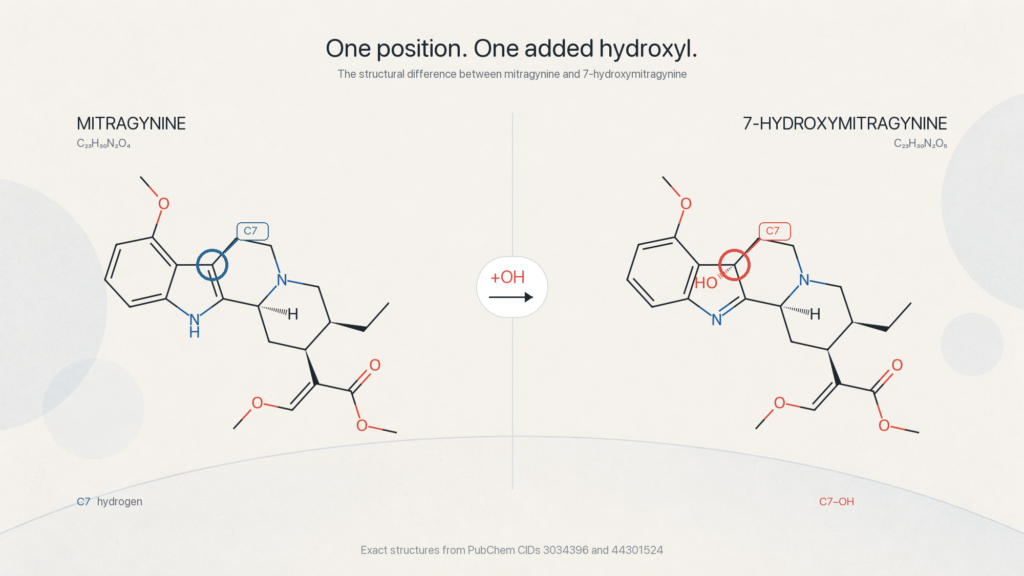
This modification gives the molecule a new “handle” that changes how it fits into opioid receptors. Chemists call this “increasing hydrogen-bonding potential,” but in practical terms, it means the molecule binds to the mu-opioid receptor more securely and activates it more strongly than mitragynine does. Even though the rest of the structure remains largely unchanged, the added oxygen dramatically boosts potency.
This is the molecular version of swapping a key’s smooth edge for a sharper cut: a tiny change that suddenly makes it fit a different lock much better.
Nothing else about the molecule’s broad structure needs to change for this to happen. Just one extra oxygen group is enough to shift the effect profile from mild, balanced stimulation to noticeably stronger opioid-like physical relief. It’s a small chemical difference with disproportionately large biological consequences.
This effect is similar to the difference between “amphetamine” and “methamphetamine,” where the latter is the form with a methyl group attached. That methyl group gives it more intense effects than amphetamine alone.
How Mitragynine Works In The Body
Mitragynine affects the body through several interconnected receptor systems. Its pharmacology doesn’t fit neatly into the categories of classical stimulants, sedatives, or opioids. Rather, its effects stem from how it blends multiple pathways.
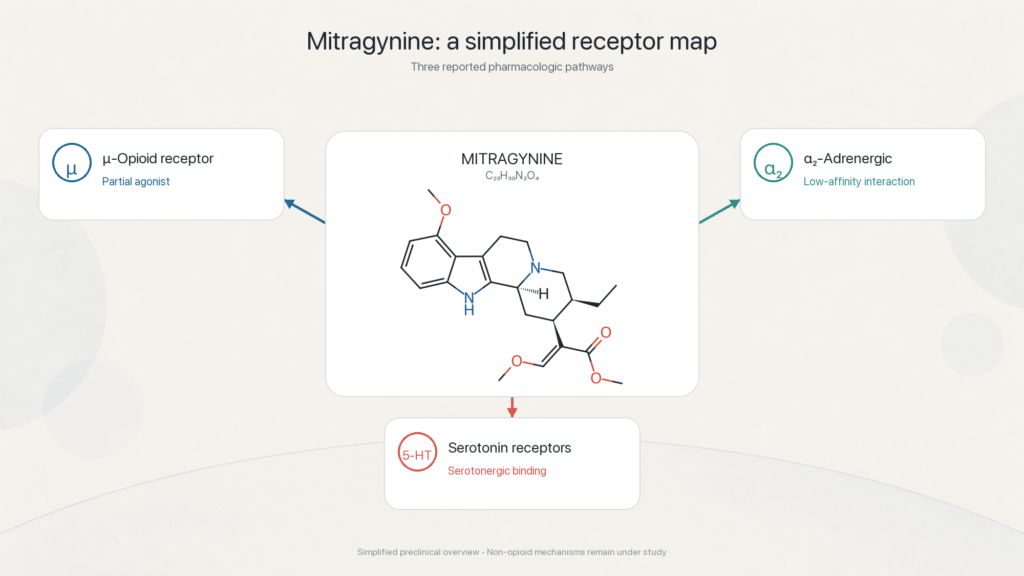
Mitragynine binds to the μ-opioid receptor (MOR) as a partial agonist. A simple way to understand this is: a classical opioid “turns the lock all the way.” Mitragynine “turns it halfway.”
This produces noticeable relief and relaxation, but with a far lower risk of the heavy sedation and respiratory depression associated with full opioid agonists like morphine or heroin.
However, partial agonism still means tolerance and dependence can develop with heavy or long-term use, so moderation and rotation matter just as much here as with any other compound that interacts with these receptors.
Adrenergic System Effects
One of the lesser-known, but highly important, ways mitragynine works in the body is by interacting with alpha-2 adrenergic receptors. These are the same receptors targeted by prescription medications like clonidine and guanfacine, which are often used to manage ADHD, blood pressure, and hyperarousal.
The alpha-2 system acts like a regulatory brake on the brain’s stress chemistry. Instead of speeding you up like caffeine or amphetamines, activating these receptors turns down the release of norepinephrine, the neurotransmitter that drives arousal, alertness, and the fight-or-flight response.
When mitragynine engages this pathway, it contributes to a calmer, more composed physiological state. This helps explain why certain kratom strains, depending on their mitragynine levels, make you feel grounded or “clear-headed” even though they aren’t sedatives. By gently reducing excessive norepinephrine release, mitragynine supports a kind of relaxed alertness rather than jittery stimulation.
Mitragynine’s effects on focus make even more sense when you understand how the brain’s electrical rhythm works. Your mental state, whether stressed, calm, deep in thought, or daydreaming, corresponds to different brainwave frequencies measured in hertz (Hz).
- Low beta (12-15 Hz): calm, locked-in focus
- Mid beta (15-20 Hz): active engagement
- High beta (20+ Hz): mental noise and overstimulation
Mitragynine’s activation of alpha-2 adrenergic receptors reduces norepinephrine release. Medications that use this same mechanism, like clonidine and guanfacine, have been shown on EEG to shift the brain out of high-beta, overstimulated activity into the calmer, more productive low-to-mid beta range.
We don’t yet have EEG studies on kratom specifically, but the mechanism should be similar: less norepinephrine leads to less high-beta chaos, which leads to smoother, cleaner focus.
That’s why, on kratom, you can think deeply and work steadily without the racing mind or fight-or-flight tension. You’re not drifting into theta (daydreaming), and you’re not slipping into alpha (relaxed to the point of zoning out). You stay anchored in the productive middle zone.
When alpha-2 receptors kick in:
- You feel calmer, but not sedated
- Background mental noise drops
- Heart rate eases down
- Focus feels controlled, not forced
- Alertness stays high without the jittery edge
Mitragynine works very differently from caffeine, which blocks adenosine receptors and ramps up sympathetic nervous system activity. Caffeine can push you deeper into high-beta, jittery alertness. Mitragynine does the opposite: it creates a smoother, grounded kind of energy, especially with white kratom strains.
Serotonergic System Effects
The serotonergic system refers to the network of neurons, receptors, enzymes, and pathways in the brain and body that use serotonin (5-hydroxytryptamine or 5-HT) as their primary chemical messenger. It’s one of the major neuromodulatory systems in the human nervous system, along with the dopaminergic (dopamine), adrenergic (norepinephrine), and cholinergic (acetylcholine) systems.
5-HT Receptor Activity
Mitragynine shows secondary interaction with certain serotonin receptor sites. These effects are milder than its opioid or adrenergic actions but still meaningful. Through this serotonergic modulation, mitragynine can support:
- Improved mood
- Emotional stability
- A calmer, steadier mental state
- A smoother sense of well-being
This is why kratom users often feel more emotionally controlled compared to traditional stimulants, which can spike stress chemistry and increase jitteriness.
The Combined Effect Of Mitragynine Activating Both Systems
Mitragynine’s unique pharmacology comes from how its different receptor actions blend together:
- Partial opioid activity → moderate relief and relaxation
- Alpha-2 adrenergic activity → calm focus and mental clarity
- Serotonergic modulation → mood support and emotional balance
Because these systems overlap, mitragynine doesn’t fit into any single category. It isn’t a classical opioid, it isn’t a stimulant, and it isn’t strictly a calming-only chemical. However, it shares qualities with all three in a distinctive, balanced way.
Mitragynine Extract Products
Whole-leaf kratom powder is the traditional form, but most of the growth in the kratom market has been in concentrated products. All of them start the same way: alkaloids are pulled out of the leaf with a solvent, then reduced down into something far more concentrated than the plant material they came from.
- MIT Kratom Shots. Small bottles of liquid concentrate, usually 15-60ml, sold at gas stations and smoke shops as much as online. A single 150mg mitragynine extract shot can contain the alkaloid equivalent of 10 grams of leaf powder. Labels vary wildly in how clearly they state the actual MIT content per bottle.
- Tablets and Capsules. Pressed mitragynine tablets and filled capsules are the most portion-controlled formats, since each unit contains a fixed amount. Some are plain leaf powder; others are extract-based, which is a meaningful difference the label should spell out.
- Enhanced Kratom. Leaf powder with mitragynine extract blended back into it. It looks and behaves like regular powder but carries a higher alkaloid load, which is exactly why it’s easy to misjudge if you’re used to plain leaf.
- Kratom Gummies. One of the most popular mitragynine-based products right now: pre-portioned, no bitterness, no measuring. Most brands sell them pre-measured with 15mg, 30mg, 50mg, or 100mg of mitragynine per piece, which is a wide range for something that looks identical from one package to the next. Check the label and COA for the MIT content in a single gummy before assuming one piece equals one serving.
Two things are worth keeping in mind across every one of these. First, concentration changes the alkaloid ratio, not just the amount. Extracts can carry a much higher proportion of 7-OH than natural leaf, which can shift the effect profile toward something more opioid-like. Second, concentrated products build tolerance faster than whole leaf for exactly that reason. If you’re weighing whether a concentrate belongs in your routine at all, our breakdown of kratom extract vs powder covers the tradeoffs in more detail.
Why Lab Testing Is Important For Measuring Mitragynine
Every kratom strain contains mitragynine, but kratom mitragynine levels vary from strain to strain, and even between batches of the same strain. That’s part of why strains can effect people so differently. Reputable vendors rely on High-Performance Liquid Chromatography (HPLC), the industry-standard method for measuring mitragynine and other alkaloid levels.
HPLC separates the chemical compounds in the leaf and quantifies them by their elution times from a specialized column. It’s a fast and highly accurate method for determining the exact percentages of mitragynine, 7-hydroxymitragynine, and other key alkaloids in a sample.
However, testing kratom doesn’t stop at measuring its alkaloid content.
It also includes microbial testing (for bacteria such as E. coli and Salmonella), heavy metal screening (for lead, arsenic, cadmium, and mercury), pesticide testing, and mold testing. Any vendor that includes these COAs gives customers a full picture of product purity, safety, and freshness. For mitragynine specifically, the test will clearly list its percentage by weight, allowing users to compare batches and verify strain consistency.
At Mount Kratom, every batch ships with a Certificate of Analysis (COA) from a third-party ISO-accredited lab, with mitragynine percentage listed clearly.
Transparency matters because not all kratom on the market is handled the same way. You never know who is adding what, where it was sourced from, or even if it’s actually kratom.
The supplement industry is notoriously unregulated, so make sure you do your due diligence and only purchase from a vendor that posts their lab results and regularly updates them.
Is Mitragynine Safe? Safety, Tolerance, and Responsible Use
As with any substance that interacts with the brain’s receptors, tolerance can develop over time. Regular, repeated use causes those receptors to adapt, meaning the body becomes accustomed to the alkaloid’s presence.
When tolerance rises, users may feel diminished effects compared to their initial experiences. This adaptation is not unique to kratom; it’s a general feature of many compounds that influence neurotransmitter pathways, including caffeine, nicotine, and other botanicals.
Anyone who has ever tried to quit smoking or drinking coffee knows exactly what this feels like, and similar withdrawal symptoms can happen to some people with kratom.
Many experienced users incorporate practices such as rotating strains, spacing out servings, or taking periodic breaks to help maintain sensitivity and keep tolerance in check.
Because kratom’s effects vary by strain, potency, and individual physiology, it’s wise to start with a modest mitragynine dosage, pay attention to how your body responds, and avoid combining kratom with alcohol or other sedating substances.
Reputable vendors, transparency, and third-party testing also play a role in safety, ensuring the product is fresh, unadulterated, and free of contaminants.
The Bottom Line
Mitragynine is the alkaloid that makes kratom kratom. It’s the most abundant compound in the leaf, the one researchers understand best, and the one responsible for most of what people feel: a blend of calm alertness, mood support, and a mild easing of physical discomfort that doesn’t fit neatly into “stimulant,” “opioid,” or “calming herb.”
That blended profile comes from mitragynine working across three systems at once: partial activity at the mu-opioid receptor, a calming nudge to the adrenergic system, and a lighter touch on serotonin pathways. 7-hydroxymitragynine plays a real role too, but only in trace amounts in natural leaf, which is exactly why products that artificially spike it behave so differently from whole-leaf kratom.
None of this is static from batch to batch, which is why lab testing matters. A Certificate of Analysis is the only way to know what percentage of mitragynine, and what else, is actually in what you’re taking.
If you’re shopping for kratom, you deserve a product where the alkaloid content is verified, not guessed at. That’s the standard third-party testing exists to provide.
References
Core kratom / mitragynine chemistry and pharmacology
Flores-Bocanegra, L., Raja, H. A., Graf, T. N., Augustinović, M., Wallace, E. D., Hematian, S., … & Oberlies, N. H. (2020). The chemistry of kratom (Mitragyna speciosa): Updated characterization data and a comprehensive review. Journal of Natural Products, 83(7), 2165–2177.
https://pmc.ncbi.nlm.nih.gov/articles/PMC7718854/
Singh, D., Müller, C. P., & Murugaiyah, V. (2023). Pharmacology of kratom: An emerging botanical agent with stimulant, analgesic, and opioid-like properties. Psychopharmacology, 240, 1–24.
https://pubmed.ncbi.nlm.nih.gov/23212430/
Kruegel, A. C., & Grundmann, O. (2018). The medicinal chemistry and neuropharmacology of kratom: A preliminary discussion of a promising medicinal plant and analysis of its potential for abuse. Neuropharmacology, 134(Pt A), 108–120.
https://pubmed.ncbi.nlm.nih.gov/28830758/
Sharma, A., Kamble, S. H., León, F., Chear, N. J., King, T. I., Berthold, E. C., Ramanathan, S., McCurdy, C. R., & Avery, B. A. (2019). Simultaneous quantification of ten key kratom alkaloids in Mitragyna speciosa leaf extracts and commercial products by ultra-performance liquid chromatography–tandem mass spectrometry. Drug Testing and Analysis, 11(8), 1162–1171.
https://pubmed.ncbi.nlm.nih.gov/30997725/
Takayama, H. (2004). Chemistry and pharmacology of analgesic indole alkaloids from the rubiaceous plant Mitragyna speciosa. Chemical & Pharmaceutical Bulletin, 52(8), 916–928.
https://pubmed.ncbi.nlm.nih.gov/15304982/
Váradi, A., Marrone, G. F., Palmer, T. C., Narayan, A., Szabó, M. R., Le Rouzic, V., … & Majumdar, S. (2016). Mitragynine/Corynantheidine pseudoindoxyls as opioid analgesics with μ agonism and δ antagonism, without β-arrestin-2 recruitment. Journal of Medicinal Chemistry, 59(18), 8381–8397.
https://pubmed.ncbi.nlm.nih.gov/27556704/
Shellard, E. J. (1974). The alkaloids of Mitragyna with special reference to those of Mitragyna speciosa. Journal of Ethnopharmacology, 1(2), 193–199.
https://pubmed.ncbi.nlm.nih.gov/4607551/
Macko, E., Weisbach, J. A., & Douglas, B. (1972). The alkaloids of Mitragyna speciosa (kratom). Journal of Pharmaceutical Sciences, 61(10), 1581–1587.
https://pubmed.ncbi.nlm.nih.gov/4626477/
Singh, D., Müller, C. P., & Vicknasingam, B. K. (2016). Kratom (Mitragyna speciosa) dependence, withdrawal symptoms and craving in regular users. Drug and Alcohol Dependence, 160, 132–137.
https://pubmed.ncbi.nlm.nih.gov/24698080/
Verpoorte, R., & Memelink, J. (2000). Engineering secondary metabolite production in plants. Current Opinion in Biotechnology, 11(2), 181–187.
https://pubmed.ncbi.nlm.nih.gov/10746874/
Receptor systems and neuropharmacology (mechanism support)
Dhaliwal, A., & Gupta, M. (2025). Physiology, opioid receptor. In StatPearls. StatPearls Publishing.
https://www.ncbi.nlm.nih.gov/books/NBK546642/
Herman, T. F., Cascella, M., & Muzio, M. R. (2025). Mu receptors. In StatPearls. StatPearls Publishing.
https://www.ncbi.nlm.nih.gov/books/NBK551554/
Nichols, D. E., & Nichols, C. D. (2008). Serotonin receptors. Chemical Reviews, 108(5), 1614–1641.
https://pubmed.ncbi.nlm.nih.gov/18476671/
Millan, M. J., et al. (2008). Signaling at G-protein-coupled serotonin receptors. Pharmacology & Therapeutics, 119(3), 268–354.
https://pubmed.ncbi.nlm.nih.gov/18676031/
Graham, R. M. (1990). Adrenergic receptors: Structure and function. Cleveland Clinic Journal of Medicine, 57(5), 481–491.
https://pubmed.ncbi.nlm.nih.gov/2164898/
Fornai, F., Blandizzi, C., & del Tacca, M. (1990). Central alpha-2 adrenoceptors regulate central and peripheral functions. Pharmacological Research, 22(5), 541–554.
https://pubmed.ncbi.nlm.nih.gov/2177556/
Giovannitti, J. A., Jr., Thoms, S. M., & Crawford, J. J. (2015). Alpha-2 adrenergic receptor agonists: A review of current clinical applications. Anesthesia Progress, 62(1), 31–39.
https://pmc.ncbi.nlm.nih.gov/articles/PMC4389556/
Arnsten, A. F. (2011). Catecholamine influences on dorsolateral prefrontal cortical networks. Biological Psychiatry, 69(12), e89–e99.
https://pubmed.ncbi.nlm.nih.gov/21489408/
Arnsten, A. F. T. (2009). Stress signalling pathways that impair prefrontal cortex structure and function. Nature Reviews Neuroscience, 10(6), 410–422.
https://pubmed.ncbi.nlm.nih.gov/19455173/
Lukas, S. E., Mendelson, J. H., Benedikt, R., & Jones, R. T. (1986). EEG, performance, and mood effects of clonidine in healthy volunteers. Neuropsychopharmacology, 1(2), 103–113.
https://pubmed.ncbi.nlm.nih.gov/2309039/
Sheth, S., Brito, R., Mukherjea, D., Rybak, L. P., & Ramkumar, V. (2014). Adenosine receptors: Expression, function and regulation. International Journal of Molecular Sciences, 15(2), 2024–2052.
https://pmc.ncbi.nlm.nih.gov/articles/PMC3958836/
Caffeine, nicotine, and comparative psychoactive context
Fredholm, B. B., Bättig, K., Holmén, J., Nehlig, A., & Zvartau, E. E. (1999). Actions of caffeine in the brain with special reference to factors that contribute to its widespread use. Pharmacological Reviews, 51(1), 83–133.
https://pubmed.ncbi.nlm.nih.gov/10049999/
Heckman, M. A., Weil, J., & Gonzalez de Mejia, E. (2010). Caffeine (1,3,7-trimethylxanthine) in foods: A comprehensive review. Journal of Food Science, 75(3), R77–R87.
https://pubmed.ncbi.nlm.nih.gov/20492310/
Domino, E. F. (1998). Tobacco smoking and nicotine: A neurobiological addiction. Progress in Brain Research, 125, 1–7.
https://doi.org/10.13140/2.1.5173.6645
Plowman, T., & Rivier, L. (1983). Coca chewing and the botanical origins of cocaine. Journal of Ethnopharmacology, 8(1), 1–38.
https://www.samorini.it/doc1/alt_aut/lr/plowman-coca-chewing-and-the-botanical-origins-of-coca.pdf
General chemistry/reference data
National Center for Biotechnology Information (2025). PubChem Compound Summary for CID 798, Indole. Retrieved December 9, 2025, from
https://pubchem.ncbi.nlm.nih.gov/compound/Indole
FAQ
Not in the classical sense. Mitragynine binds to the mu-opioid receptor as a partial agonist rather than a full agonist like morphine or heroin, and it also engages adrenergic and serotonergic systems that classical opioids don’t touch. That combination is why its effect profile looks different from traditional opioids.
Mitragynine is the dominant alkaloid in kratom, making up as much as 66% of total alkaloid content. 7-hydroxymitragynine (7-OH) is far more potent at the opioid receptor but naturally appears in trace amounts, typically less than 0.05% of the leaf. Natural kratom stays balanced because of that ratio; products that artificially raise 7-OH levels shift toward a more opioid-like profile.
Yes. Like caffeine, nicotine, and other compounds that interact with neurotransmitter pathways, regular use can lead to tolerance, and withdrawal symptoms are possible with heavy or long-term use. Rotating strains, spacing out servings, and taking periodic breaks are common ways experienced users manage this.
Because alkaloid levels vary naturally from batch to batch, the only way to know the actual mitragynine percentage, and confirm the product is free of contaminants, is through third-party testing, typically via HPLC. A proper Certificate of Analysis lists mitragynine percentage clearly alongside microbial, heavy metal, and pesticide screening.
No. Mitragynine content varies by strain, vein color, and format, which is part of why different strains feel different even though they share the same primary alkaloid. Extract-based products concentrate mitragynine well beyond what’s found in plain leaf powder or capsules.